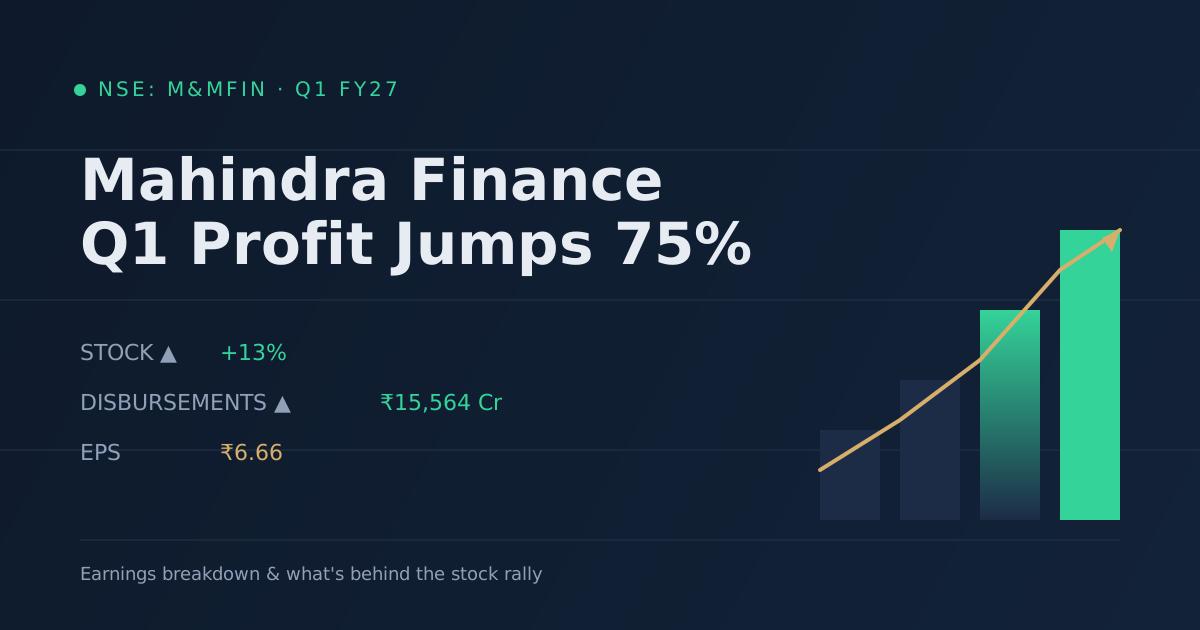
Mahindra Finance Q1 FY27: Profit Jumps 75%, Stock Soars 13%
Shares of Mahindra & Mahindra Financial Services (M&MFIN) were the standout story on Dalal Street this week, rallying nearly 13% intraday to touch ₹363 after the NBFC posted one of its strongest quarterly report cards in years. The move came right on the back of the company's Q1 FY27 results and the earnings call that followed, where management walked analysts through what's driving the turnaround.
If you've had this stock on your watchlist, or you're simply trying to understand why an NBFC just had one of its best trading days of the year, here's what actually happened in the numbers and on the call.
The headline numbers
Mahindra Finance's consolidated net profit for the quarter ended June 2026 came in at roughly ₹927 crore, up about 75% from ₹528 crore in the same quarter last year. Total income for the quarter rose 14.2% year-on-year to ₹5,725 crore, while revenue from operations grew a similar pace to ₹5,718 crore, largely powered by interest income crossing ₹4,952 crore.
Fee and commission income and income from the sale of services both grew close to 48% year-on-year, a sign that the company's non-lending revenue streams are scaling up alongside its core financing book.
What's actually driving the profit surge
A 75% profit jump on 14% income growth means the real story is below the topline — expenses grew slower than revenue, largely because impairment charges (provisions for bad loans) came down compared to last year. In plain terms: Mahindra Finance is lending more, and a smaller share of that book is turning sour.
Disbursements grew broad-based
- Overall disbursements for the quarter were around ₹15,560 crore, up roughly 21-22% year-on-year.
- Tractor financing was the standout, growing about 45% year-on-year.
- Passenger vehicle financing grew around 24% year-on-year.
- Total business assets expanded 12-13% year-on-year to around ₹1,37,300-1,37,449 crore.
Asset quality kept improving
Despite the aggressive push in disbursements, the loan book didn't deteriorate — if anything, it got healthier. Stage-2 and Stage-3 asset ratios (the company's early-warning and non-performing loan buckets) improved compared to a year ago, collection efficiency held around 95%, and liquidity on the balance sheet stayed comfortable at over ₹14,600 crore. That combination — faster growth without worse credit quality — is usually what gets a stock re-rated by the market in a single session.
Why the stock moved the way it did
M&MFIN shares opened sharply higher and touched an intraday high near ₹363, a roughly 13% jump from the previous close around ₹322-324. Trading volumes were elevated through the session as the results and the subsequent concall — led by MD & CEO Raul Rebello and CFO Pradeep Agrawal — gave the street more confidence that this wasn't a one-off beat but a broader improvement in the lending franchise.
For context, the stock had been trading well below its 52-week high of ₹412 in recent weeks, so this move also closes some of that gap. The current price still puts the stock at a price-to-earnings multiple noticeably below the NBFC sector average, which is part of why some market participants view the re-rating as still having room to run — though, as always, that view can change quickly with sentiment and macro conditions.
What this means if you're tracking the stock
For traders and investors following M&MFIN, a few things are worth keeping on the radar going forward:
- Sustainability of the credit cost improvement — a single strong quarter on provisions is encouraging, but the trend needs to hold for a few more quarters to confirm a structural shift rather than a cyclical dip.
- Rural demand momentum — with tractor financing leading growth, monsoon progress and rural cash flows will matter for how this segment performs through the rest of FY27.
- Valuation re-rating — a 13% single-day move compresses the valuation gap versus peers quickly; how the stock behaves in the days after the initial reaction often tells you whether the move is being absorbed calmly or chased aggressively.
- Debt-equity levels — the reported debt-to-equity ratio near 4.97x is a reminder that this is a leveraged lending business, and funding costs matter as much as loan growth.
The bottom line
Mahindra Finance's Q1 FY27 print checked most of the boxes markets look for from an NBFC: strong disbursement growth, expanding margins, improving asset quality, and a management commentary that reinforced confidence in the trajectory. That combination is why the stock had one of its sharpest single-day moves in recent memory. Whether the rally holds will depend on execution over the next couple of quarters rather than this one print alone.